What Happens When a Commercial Construction Project Encounters Rock, Bad Soil, or an Underground Surprise?
A practical Nashville commercial construction guide to subsurface risk, differing site conditions, cost, and schedule impact.
Picture a commercial project in the Nashville area moving right on schedule. Excavation begins, and only a few feet below grade, the bucket stops on solid limestone that was not clearly identified in the plans.
Now the project team has decisions to make. Does the rock need to be removed? Can the footing elevation change? Will a hoe-ram handle it, or will blasting be required? What does it mean for the underground utilities? How much time will it add, and who is responsible for the additional cost?
Commercial construction rarely stays as simple as the drawings make it appear, and in Middle Tennessee, subsurface conditions are one of the biggest reasons why. An experienced Nashville general contractor plans for those possibilities before the first shovel goes into the ground.
Anyone who has built around Nashville knows that rock is part of the territory.
Nashville Does Not Build on Flat, Predictable Ground
Nashville and much of Middle Tennessee sit on limestone geology. Depending on the location, bedrock can be relatively shallow, while other areas may contain clay, weathered rock, unsuitable soils, historic fill, or combinations of all of them.
On most Nashville-area sites, limestone bedrock can be close enough to the surface that even relatively shallow excavation may reach it. That does not mean every project will require major rock excavation, but it does mean subsurface conditions should be considered early when planning foundations, utilities, storm drainage, grading, and other below-grade work.
Older commercial properties can present another challenge. A site may have been graded, filled, redeveloped, expanded, or partially demolished several times over decades. What is underground today may not closely resemble the original site conditions shown on old drawings.
A shallow rock shelf, unsuitable soil, undocumented fill, or an abandoned utility does not necessarily make a site problematic. It simply becomes something the design and construction team needs to identify, understand, price, and manage.
What Hitting Rock or Bad Soil Actually Looks Like on Site
Solid Rock and Bedrock
When a footing, storm line, sanitary sewer, water line, or other excavation hits solid limestone, normal excavation production can change dramatically. A conventional excavator may no longer be able to simply dig the material.
Depending on the amount and hardness of the rock, contractors may use hydraulic hammers or hoe-rams, larger excavation equipment, rock saws or trenching equipment, or specialty blasting contractors. Each method affects production, cost, and schedule differently.
Rock excavation can be particularly significant for underground utilities because the excavation may extend hundreds or thousands of feet across a project. A relatively small difference in anticipated rock depth can become a major cost difference when multiplied across an entire utility system.
That is why geotechnical investigation matters before pricing foundations, utilities, and other below-grade work. A good geotechnical report does not eliminate every subsurface surprise, but it gives the contractor and design team much better information from which to make decisions and establish realistic budgets.
Unstable or Unsuitable Soil
Rock is not the only underground condition that can create problems. Sometimes the problem is exactly the opposite.
Soil may be too soft, too wet, poorly compacted, highly plastic, or otherwise unsuitable to support the building, pavement, or utility installation as designed.
When that occurs, the affected material may need to be over-excavated and replaced with engineered fill, stabilized with lime or cement, dried and recompacted, or addressed through another geotechnical recommendation.
Those corrective measures take time and money, but ignoring unsuitable soil can create much larger problems later. Building slabs can settle. Pavement can fail. Utility trenches can move. Foundations can experience differential settlement. Correcting the ground properly before construction continues is almost always less expensive than repairing a completed project later.
Utilities and Structures Nobody Flagged
Older commercial corridors around Nashville also have history underground. Contractors may encounter abandoned utility lines, old foundations, drainage structures, buried concrete, previous building slabs, undocumented piping, old tanks, or other remnants of earlier development.
Utility records are extremely important, but records do not always reflect every abandoned or private utility that has existed on a property. Tennessee 811 utility locating is an essential part of excavation planning, but contractors also have to understand that private utilities and abandoned systems may not always be identified through the standard utility-locate process.
That is where experience matters. A contractor needs to recognize when something in the field does not match the drawings and know when to stop, document the condition, notify the appropriate parties, and determine the correct path forward before continuing excavation.
Who Actually Pays for What Nobody Could See Coming?
This is one of the most important questions for an owner, developer, or property manager. The answer depends on the construction contract, the information available before bidding, and the specific condition encountered.
Many commercial construction contracts contain provisions addressing differing site conditions. Generally, these provisions establish a process for handling subsurface or concealed conditions that materially differ from what was represented in the contract documents or what could reasonably have been anticipated.
The details matter. When an unexpected condition is discovered, the contractor should document it before disturbing the area further whenever practical. That can include photographs, measurements, elevations, daily reports, equipment and labor records, and notification to the owner and design team.
The objective is not simply to create paperwork. It is to establish what was encountered, how it differs from the anticipated condition, what has to change, and what impact the condition will have on cost and schedule.
A well-managed differing-site-condition process protects both the owner and the contractor. The owner understands why additional work is required. The contractor has documentation supporting the additional cost. The design team has the information needed to evaluate the condition and provide direction. Without that process, a relatively straightforward underground issue can become a much larger dispute later.
The contract may determine who writes the check, but an unforeseen underground condition can affect everyone on the project through added cost, added decision time, and added schedule duration.
Experience Below Grade Matters
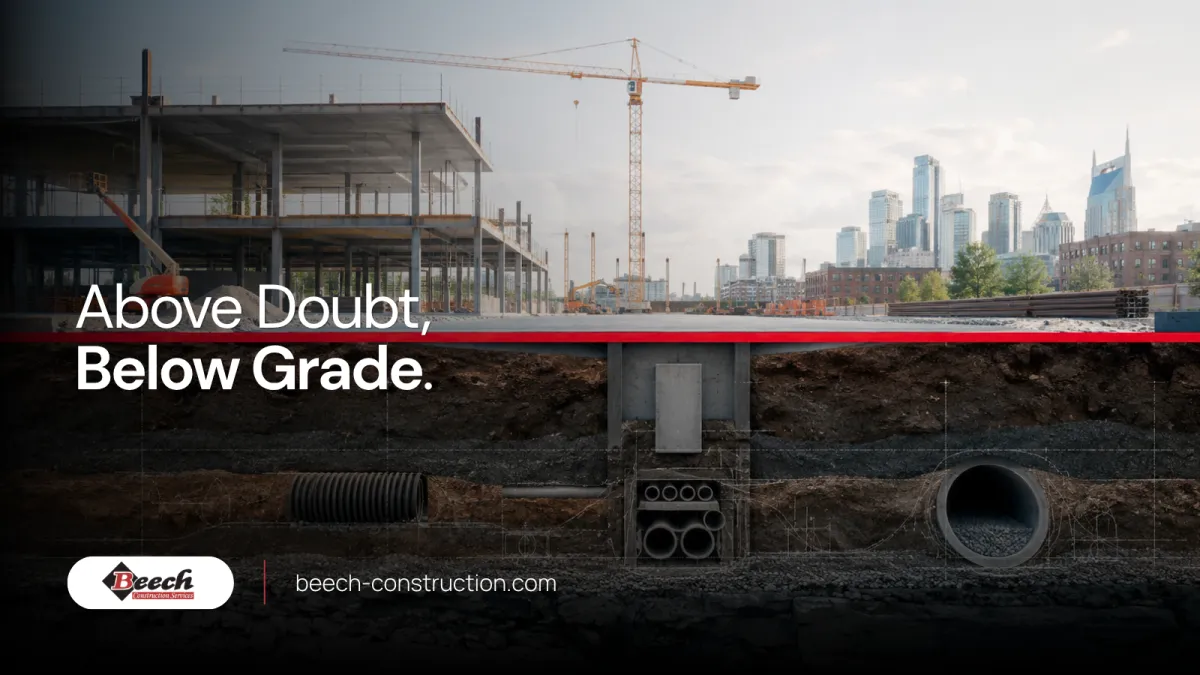
A commercial general contractor may ultimately be judged by the finished building, but a significant amount of project risk exists before anything is visible above grade.
Beech Construction Services has been working in Middle Tennessee since 1993 across commercial construction, industrial projects, renovations, concrete construction, civil work, site development, and underground utilities. That experience matters when difficult site conditions arise.
Beech also brings direct, hands-on experience in site work and underground utilities. While we do not self-perform every site work or utility scope on every project, maintaining our own experienced personnel and capabilities in these trades gives our project teams a practical understanding of excavation, rock removal, utility installation, production requirements, equipment needs, and the risks that can affect cost and schedule.
That knowledge remains valuable even when a portion of the work is subcontracted. Because we perform this type of construction ourselves, our project teams are better equipped to evaluate subcontractor pricing, understand production assumptions, recognize unrealistic schedules, review means and methods, and identify potential problems before they become larger issues.
The question is not simply whether the general contractor owns an excavator. The more important question is whether the contractor understands what should be happening when that excavator starts digging.
What to Do Before You Break Ground
Obtain Geotechnical Information Early
For projects involving new foundations, substantial grading, underground utilities, pavement, or other significant below-grade construction, geotechnical information should be obtained early enough to affect design and budgeting.
Soil borings can provide information about anticipated rock elevations, soil classifications, groundwater, bearing capacity, unsuitable materials, and other site conditions. That information allows the contractor to price against actual engineering data rather than broad assumptions.
Investigate Existing Utilities
Existing utility information should be gathered and reviewed during preconstruction. That can include utility maps, record drawings, previous surveys, Tennessee 811 locates, private utility locating when warranted, and conversations with property owners or facility personnel who may know the history of the site.
No single source is perfect. Using several sources together provides a much clearer picture of what may be underground.
Build Appropriate Contingency Into the Budget
Every project should account for uncertainty. For sites with known rock, significant grading, older development, undocumented fill, or substantial underground utility work, an appropriate contingency can prevent every unexpected condition from becoming a financial crisis.
Contingency should not be treated as an excuse for poor estimating. It is a management tool for risks that cannot reasonably be quantified with certainty before work begins.
Define the Change-Order Process Before Construction
Owners and contractors should also agree on how unexpected conditions will be handled before they occur. Who receives notice? Who has authority to direct the work? What documentation is required? Can work proceed under a notice to proceed while final pricing is being developed? How will labor, equipment, materials, subcontractors, and schedule impacts be documented?
These questions are much easier to answer in a preconstruction meeting than while equipment is sitting idle beside an open trench.
Choosing a Nashville General Contractor Who Understands the Ground
Commercial construction experience is not measured only by the number of buildings a contractor has completed. Local experience matters because local conditions repeat themselves.
A contractor that has excavated foundations, installed underground utilities, managed mass grading, worked through limestone, corrected unsuitable soils, and dealt with existing commercial sites throughout Middle Tennessee approaches a project differently from someone encountering those conditions for the first time.
That experience improves estimating. It improves planning. It improves subcontractor management. And when something unexpected does happen, it improves the speed and quality of the decision-making needed to keep the project moving.
When evaluating a Nashville commercial general contractor, owners and developers should ask about more than the building itself. Ask what the contractor knows about what is underneath it.
Frequently Asked Questions
What happens if a general contractor hits rock during excavation?
The contractor should first determine the extent and type of rock encountered and compare the actual condition with the contract documents, geotechnical information, and assumptions used during bidding.
Depending on the condition, removal may involve a hydraulic hammer or hoe-ram, specialized rock excavation equipment, saw cutting, trenching equipment, or blasting. The contractor should also document the condition and notify the owner and design team when the rock represents a differing site condition or will materially affect cost or schedule.
Who pays for unexpected underground conditions on a commercial project?
In practical terms, everyone involved in the project can feel the impact of a truly unforeseen underground condition.
The construction contract will determine who is ultimately responsible for the direct cost of the changed condition. If the actual condition materially differs from what was represented in the contract documents or could reasonably have been anticipated, the contractor may be entitled to an adjustment in the contract price, the schedule, or both.
But the impact usually goes beyond the cost of the additional excavation, rock removal, soil correction, or utility work itself.
An unexpected condition can stop or slow work while the condition is investigated, documented, priced, reviewed, and approved. Engineers may need to provide direction. The owner may need to authorize additional cost. Crews and equipment may need to be reassigned or remain idle. Follow-on trades may be delayed. Even after the solution is agreed upon, additional time is then required to physically perform the changed work.
That means an unforeseen condition can affect the owner, contractor, subcontractors, design team, and ultimately the overall project schedule - even when the contract clearly assigns the direct cost to one party.
This is why early geotechnical investigation, good site information, clear contract language, prompt documentation, and a well-defined change-order process are so important. They may not eliminate the surprise, but they can significantly reduce the time and cost required to resolve it.
Do I need a geotechnical report before starting a commercial project in Nashville?
For most ground-up projects and projects involving new foundations, significant site work, or substantial underground utilities, a geotechnical investigation is an important part of preconstruction.
Anyone who has built around Nashville knows that rock is part of the territory. Limestone can be relatively shallow, and conditions can vary significantly across the same property.
A geotechnical report provides much better information for foundation design, excavation planning, utility installation, and construction budgeting. For a simple interior tenant renovation with little or no below-grade work, a geotechnical investigation may not be necessary.
How common are underground surprises on commercial projects in Nashville?
They are common enough that experienced Middle Tennessee contractors plan for the possibility. Rock, unsuitable soils, historic fill, abandoned utilities, old foundations, and undocumented underground structures can all occur.
The likelihood varies significantly by property, which is why site history, geotechnical information, surveys, existing utility information, and local construction experience should all be considered during preconstruction.
How does Beech Construction Services handle rock, bad soil, or hidden utilities on a job site?
Beech begins by reviewing the available geotechnical information, civil plans, utility information, and site conditions during preconstruction.
When an unexpected condition is discovered, our approach is to document the condition, communicate it quickly, determine what is required to proceed safely and correctly, evaluate the cost and schedule implications, and establish clear direction before moving forward.
Beech also has direct self-perform experience in site work, excavation, concrete, and underground utilities. We do not self-perform every scope on every project. However, because our team performs this type of work directly, we understand the equipment, labor, production, sequencing, and field conditions involved.
That allows us to manage both our own crews and qualified subcontractors from a position of practical construction knowledge.
What should I ask a general contractor about site conditions before signing a contract?
Ask whether the contractor has reviewed the geotechnical report and what concerns they see. Ask what assumptions are included in their earthwork, foundations, and underground utility pricing. Ask how rock excavation is addressed. Ask how unsuitable soils will be handled. Ask how unknown utilities or differing site conditions are documented and priced. And ask about the contractor's actual experience performing and managing site work in Middle Tennessee.
A contractor with meaningful local experience should be able to give specific answers rather than simply saying, "We'll deal with it if we find something."
The goal is not to eliminate every underground surprise. The goal is to have a project team that knows what to do when one appears.