
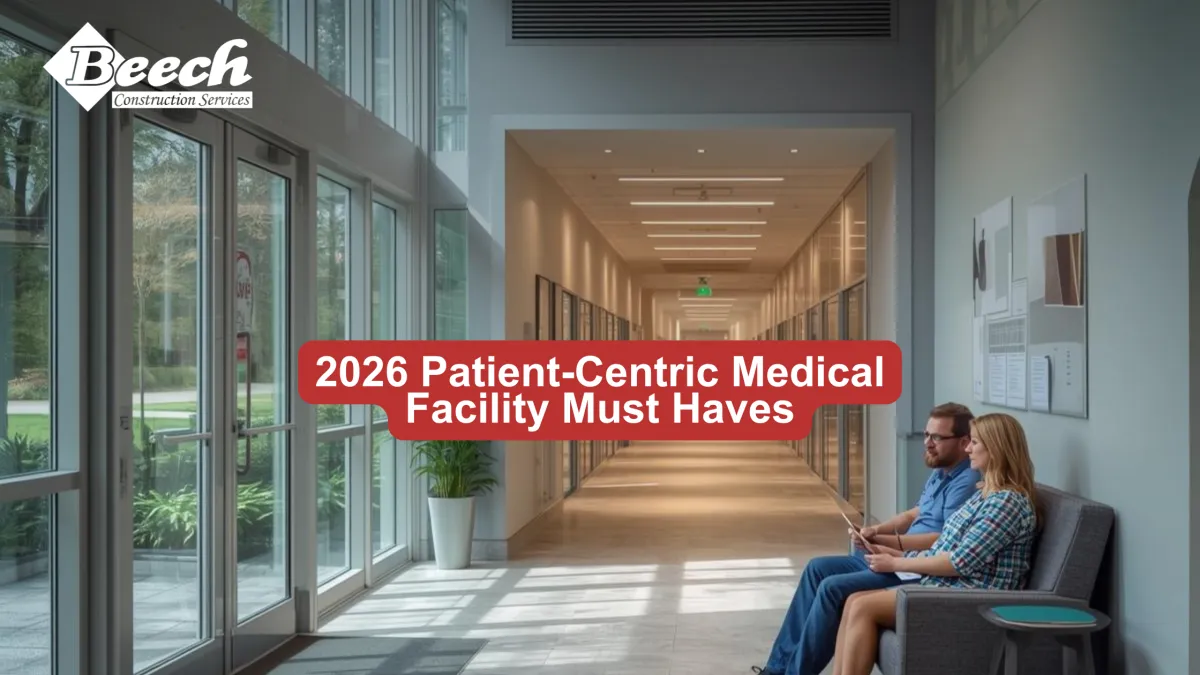
Designing Patient-Centric Medical Facilities in 2026: Construction Must Haves
Why 2026 Projects Look Different
Ambulatory and outpatient volumes continue to rise. According to the 2025 AHA Annual Survey, outpatient visits grew 18 % year over year while inpatient days fell 4 %. That shift explains the surge in Google searches for “patient-centric design” and “outpatient clinic build.”
Modern patients expect:
• Safe environments that actively reduce infection risk
• Friction-free digital touchpoints from pre-registration to follow-up
• Spaces that feel more like hospitality than hospital
Meeting those expectations starts long before the ribbon-cutting. It starts with medical facility construction strategies built around flexibility, technology, and the human experience. Let’s dive into the must-haves every 2026 project team should be planning now.
1. Infection-Control Materials: Engineering Out Pathogens
Hospital-acquired infections still cost U.S. systems an estimated $28–45 billion annually, but construction teams can lower that tally dramatically.
Key material moves:
Seamless, non-porous finishes
• Sheet vinyl flooring heat-welded at the seams eliminates grout lines and quarry-tile fissures where microbes hide.
• Solid surface wall protection behind sinks replaces tile splash zones prone to mold.Antimicrobial alloys at touch points
• Copper-nickel door levers, handrails, and sink fixtures kill up to 99.9 % of bacteria within two hours.
• Stainless steel with silver-ion coatings offers a cost-friendly alternative in low-traffic areas.UV curable floor coatings
• A 4 hour cure time versus days for epoxy slashes downtime between construction phases.
• Durability extends the strip and wax cycle to 5 + years, reducing both lifecycle cost and chemical exposure.Modular wall systems
• Factory-finished panels arrive sterile and can be swapped in hours if contamination occurs, avoiding drywall demolition and airborne dust.High-performance air barriers
• Self-adhered membranes paired with MERV-13 (or better) filtration limit infiltration points for contaminants (even in high-humidity climates).
Remember: specify products with Environmental Product Declarations (EPDs) or Health Product Declarations (HPDs) to satisfy both infection-control and sustainability scorecards—an increasingly common RFP line item.
2. Flexible Treatment Rooms: Design Once, Use a Hundred Ways
Value-based reimbursement rewards facilities that can pivot quickly. The same suite may need to host a dermatologist on Monday, a pain-management procedure on Tuesday, and tele-rehab consults the rest of the week.
Construction tactics that enable that agility:
• Overhead utility booms bring gases, power, and data to the patient rather than anchoring the patient to the wall.
• Demountable partitions rate STC 45+ so rooms can expand or subdivide without re-framing.
• Raised access floors in admin zones hide bundled power/data—perfect for fast reconfiguration as team sizes shift.
• Under-slab raceways in imaging and surgery pods: drop extra conduit day one, cap it, and avoid X-ray core drilling later.
• Universal headwall infrastructure standardized across rooms eliminates the “wrong gases in the wrong room” remodel.
Pro move: prototype a mock exam room in a warehouse early in design. Invite clinicians to run simulations, then tweak boom reach, cabinet height, and lighting before construction dollars lock in.
3. Telehealth & the Digital Front Door: Infrastructure Patients Feel
Virtual visits climbed another 38 % in 2025. But tele-ready facilities aren’t just about bandwidth; they’re about trust. Patients need to see and feel that technology enhances, not replaces, care.
Construction checklist:
Robust Connectivity
• Wi-Fi 6E access points every 1,800 sq ft and Cat-6A cabling in every wall keep the network future-proof.
• Distributed antenna systems (DAS) erase cellular dead zones—vital for remote-monitoring devices.Acoustic Privacy
• Video-visit pods near lobbies rated STC ≥ 45 prevent HIPAA-violating eavesdropping.
• Install automatic door bottoms and acoustic seals; leaks often occur under the door, not through walls.Power & Thermal Planning
• Edge servers supporting AI diagnostics or imaging compression throw off heat; add dedicated HVAC zones and power redundancy.
• Specify white space (30–40 % empty rack capacity) so new blades slide in without rewiring.IoT-Friendly Building Management
• Sensors feeding real time IAQ dashboards reassure immune-compromised visitors.
• Smart lighting synced to circadian rhythms improves patient satisfaction scores by 12 % in recent HCAHPS trials.Wayfinding Layers
• Digital kiosks, color-coded LED ceiling strips, and app-driven indoor GPS shorten “door to exam” time—correlating strongly with positive reviews.
4. Human-Centered Amenities: From Parking Lot to Discharge
Patient-centric design extends beyond clinical spaces. Consider the journey:
• Biophilic Entrances – Use clerestory windows, living walls, and daylight to lower cortisol levels before check-in.
• Family Zones – Alcoves with USB-C charging, soft seating, and views reduce perceived wait times by up to 23 %.
• Multi-Faith Quiet Rooms – A single adaptable space (dimmable lighting, ablution sink, stackable seating) respects diverse spiritual needs without footprint bloat.
• Sensory-Friendly Detailing – Rounded wall corners, sound-absorbing ceiling clouds, and low-contrast patterns help neurodiverse patients navigate calmly.
• Touchless Journeys – From automatic license-plate parking gates to elbow-activated door openers and voice-controllable elevators, fewer touch points mean fewer vectors.
Design tip: Map patient “emotional hot spots” with staff. Long on-hold times? Add check-in kiosks. Post-op anxiety? Locate a discharge pharmacy adjacent to the pick-up zone, so caregivers never leave recovery patients alone.
5. Sustainability Equals Wellness: The Overlooked Patient Benefit
Environmentally conscious construction isn’t just about LEED plaques, it’s about breathing easier indoors.
Sustainable moves that double as patient-centric features:
• Electrochromic glazing automatically tints to control glare, keeping patients comfortable without heavy drapes that trap dust.
• Geo-thermal or VRF systems offer quieter mechanical rooms, aiding rest in adjacent recovery bays.
• Low-VOC everything (paints, sealants, adhesives) keeps TVOC counts below 500 µg/m³, the threshold where headaches spike.
• Rainwater reclamation feeds irrigation for healing gardens—patients who view greenery need 8 % less pain medication on average.
• Embodied-carbon accounting: Choose lower-carbon concrete or mass-timber hybrid structures; marketing can spotlight the climate benefit, strengthening community goodwill.
6. Regulatory & Future-Proofing Considerations
2026 will bring new rules:
• USP 800 enforcement spreads from hospitals to outpatient oncology suites—plan negative-pressure compounding rooms now.
• ASHE Energy Chapter updates push for sub-metering major mechanical loads; include breaker capacity in the main switchboard.
• Seismic & wind codes tightening in Gulf and Pacific states favor base-isolated foundations and buckling-restrained braces—account for the added height early to avoid elevator overruns.
• AI diagnostics and robotics—allocate shielded storage for autonomous UV-C disinfection bots and ceiling tracks for robotic cath labs.
Future proofing rule of thumb: target 20 % additional capacity in data closets, medical gas branches, and roof structural live loads. That margin keeps remodels in the ceiling grid, not in the demolition dumpster.
Conclusion – Build for People, Build for Change
Patient-centric medical facility construction is more than a design trend. It’s a strategic imperative for competitive, compassionate care. By focusing on infection-control materials, flexible rooms, telehealth-ready infrastructure, wellness-driven amenities, and rigorous sustainability, you’re not just erecting a building—you’re future-proofing the entire care model.
Ready to turn these must-haves into a concrete plan? Let’s map out your 2026 medical facility construction project together. Reach out to the Beech Construction healthcare team for a feasibility chat and site assessment.